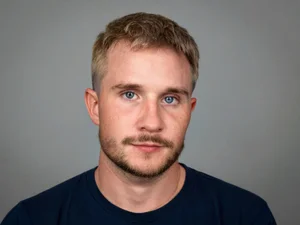
A performer walks into a studio, delivers their scene against a neutral grey background and leaves without ever setting foot in the location where the finished commercial will appear to take place.
In post-production, that performance might be placed on a busy street, inside an elaborate architectural setting or somewhere that doesn't exist at all.
This is one of the ways hybrid filmmaking is changing commercial production. Rather than building or travelling to every location, production teams can combine real performances with digitally created environments and AI-assisted visual effects.
For casting directors, it introduces a different set of questions. Not necessarily about who can act, but about what will happen to their performance after the cameras stop rolling.
What is hybrid filmmaking?
Hybrid filmmaking combines conventional live-action production with digital techniques. These might include traditional VFX, virtual production, performance capture, computer-generated imagery and AI-assisted tools.
The term is broad. A commercial filmed in front of an LED volume and a production that uses generative AI to build its backgrounds could both be described as hybrid, even though the technical workflows are quite different.
One approach attracting particular interest involves filming an actor's actual performance in a controlled studio, then using VFX to place that footage into a separately created environment.
The performer still acts. The camera still records their expressions, movement and timing. It's the world around them that changes.
For commercial producers, that can create opportunities to shoot ambitious concepts without constructing every physical environment.
It doesn't remove the need for preparation, though. Lighting, camera movement, eyelines, interaction with objects and the relationship between the actor and the eventual environment still need careful planning.
What is greyboxing in AI filmmaking?
Greyboxing, sometimes written grey-box filming or grayboxing, can describe a workflow in which performers are filmed against a neutral background under controlled conditions.
Unlike traditional green-screen production, which uses a highly saturated background to help isolate subjects, grey-box workflows may rely more heavily on digital masking, rotoscoping, tracking and AI-assisted visual processing.
The aim is to capture a usable live-action performance that can later be integrated into a digitally created scene.
The term isn't universal, however. In conventional VFX and games development, greyboxing can also mean creating rough 3D environments to establish the layout and movement of a scene before final production.
A producer asking for a grey-box shoot should therefore explain exactly which process they intend to use.
From a casting perspective, the most useful question is relatively simple:
Will the finished commercial contain the actor's recorded performance, or will the technology generate new performances using their likeness?
Those aren't necessarily the same thing.
Captured performance versus an AI-generated digital double
In a performance-preserving workflow, the actor's original filmed movements and expressions remain the basis of the finished shot. Artists may alter the background, adjust lighting or composite the performer into another environment.
A generative digital replica is different. It may enable a production to create a new performance or representation of the individual that they never physically recorded.
Both approaches can involve sophisticated visual technology, and both deserve clear contractual descriptions. But producers shouldn't treat them as interchangeable when briefing talent.
This distinction is particularly important when discussing consent, compensation and what the production is permitted to do with captured footage.
How do depth maps and motion references fit into hybrid production?
A depth map represents the approximate distance of different surfaces from the camera. It can help a visual-effects system understand how objects and people relate spatially within an image.
In certain AI-assisted workflows, depth information helps guide the arrangement of generated or altered environments, potentially making compositing more consistent.
Motion reference serves a different purpose.
An actor might perform a particular movement, a dancer might demonstrate a physical sequence, or a performer might provide reference footage for a character that will be developed digitally.
That footage can be used to guide animation, movement and visual continuity.
But the intended use matters.
A performer providing movement reference for an animated character isn't necessarily agreeing to have their identifiable face or body reproduced. Equally, a digital body scan captured for a particular commercial shouldn't automatically become a reusable asset for unrelated projects.
This is where a detailed casting brief becomes particularly valuable.
The production should explain whether it needs an actor, a motion-reference performer, a picture double, a body double or someone whose identifiable likeness will be used in the finished work.
What are AI image aggregators, and why do they matter?
An AI image aggregator is generally a platform that provides access to several generative image models or visual tools through one interface.
Creative teams may use these services to compare models, develop references, generate starting frames or experiment with environments and visual styles.
They can be useful during concept development, but productions need to understand what happens when identifiable performer material is uploaded.
An aggregator may involve multiple underlying service providers, each with different terms governing data storage, processing, retention and model training.
For work involving actors or real people, those details should be established before photographs, scans or footage are shared.
A useful distinction is whether the tools are processing footage solely to deliver the agreed production, or whether the material may also be retained or used to develop other systems.
The fact that a platform is convenient for the creative team doesn't automatically mean its terms are appropriate for identifiable talent material.
What permissions are needed for digital doubles and AI-assisted VFX?
There isn't one universal agreement that covers every form of hybrid production.
The necessary permissions depend on what is being recorded, how it will be altered, whether the performer remains identifiable and what rights the production expects to retain.
A conventional commercial release may cover a defined performance and its agreed advertising usage. That doesn't necessarily authorise the creation of an independent digital replica or the use of performance data to train an AI model.
Similarly, a production using AI-assisted rotoscoping or background replacement isn't automatically creating an independent digital version of the actor.
The important thing is to describe the actual workflow rather than relying on a broad reference to “AI”.
Before casting begins, producers should establish:
Capture: What photographs, footage, scans, movements or voice recordings are required?
Processing: Which VFX and AI-assisted techniques will be used, and by whom?
Modification: What aspects of the performance or appearance may be changed?
Usage: Which campaign, platforms, territories and durations are covered?
Retention: Where will source material be stored, who can access it and when will it be deleted?
Reuse: Can the captured material or digital likeness be used beyond the original project?
Compensation: Does the fee reflect the agreed scope of capture, usage and any additional digital rights?
For some productions, these questions can be answered through a clearly drafted commercial agreement and supporting technical documentation. Others may require specific digital-replica permissions or additional legal review.
What matters is that performers and their representatives understand what they're accepting before filming.
Does hybrid filmmaking change who gets cast?
Not necessarily.
A strong performance is still a strong performance. Timing, personality, expression and the ability to respond naturally to direction remain essential.
However, certain briefs may call for more specialised skills.
Some performers are particularly comfortable repeating movements precisely, maintaining eyelines without a physical scene partner or responding to technical direction on a relatively empty stage.
Others may be cast for physical proportions, movement characteristics or their ability to provide convincing reference for a digitally created sequence.
For real-people casting, the challenge can be different again. Someone may be perfectly suited to a campaign's creative idea but unfamiliar with a technical filming environment.
A good casting process needs to establish both their suitability for the role and their understanding of how the finished material will be produced.
How MXM Casting supports hybrid productions
At MXM Casting, we work with producers, agencies and production companies to source performers for commercial briefs that extend beyond conventional casting.
That includes actors, real people, body doubles, digital-double reference performers and talent required for specialist VFX or performance-capture work.
Our role is to establish the casting requirements, identify suitable people and help ensure that performers and their representatives receive the relevant information about the proposed production process.
We don't create the visual effects or operate the AI systems. Those decisions sit with the production and VFX teams.
But getting the casting brief right at the outset makes the process more straightforward for everyone involved.
As hybrid production develops, the distinction between a captured performance, a digitally modified performance and a newly generated one will become increasingly important.
The technology may change how a scene is made. It shouldn't obscure what the performer has actually agreed to.
Planning a commercial involving greyboxing, digital doubles or AI-assisted visual effects?
Explore MXM Casting's Digital Double Casting services, or send us your production brief to discuss the talent requirements.